July 29, 2026
Best Online Ordering Tools for Restaurants in 2026
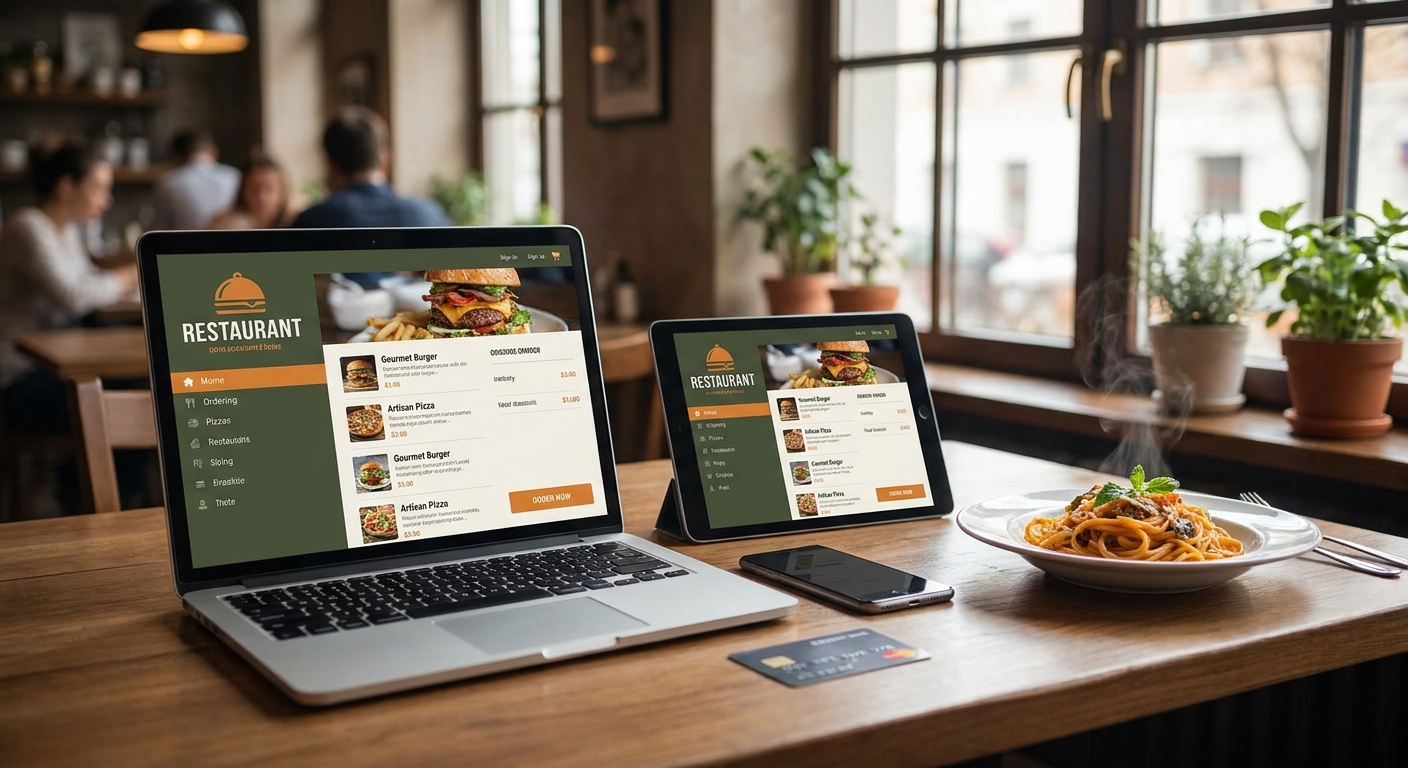
Online ordering tools turn restaurant websites into sales machines. Customers order directly from your site, you skip commission fees, and order data stays in your hands—no third-party middleman taking a cut.
This guide ranks the best online ordering tools for restaurant websites in 2026, ranked by ease of integration, cost, and fit for independent restaurants and small chains.
- Toast Go and Square Online top rankings for restaurants in 2026—flat 3% + $0.30 per transaction.
- Direct integrations with POS systems eliminate double-entry and order confusion.
- Restaurant-specific tools (Toast, Lunchbox) beat generic e-commerce builders for speed and features.
- Annual savings: restaurants on direct ordering save $4,800–$12,000 versus third-party delivery apps at 15–30% per order.
Why this matters
Third-party delivery apps—DoorDash, Uber Eats, Grubhub—take 15 to 30 percent of each order. On a 50-order Friday night at a $15 average check, that's $112 to $225 lost per night, or $1,300 to $2,600 per month. Direct ordering tools flip the economics: you own the customer, control the margins, and build a list you can email, text, or loyalty-program forever. In 2026, a website with native ordering isn't optional—it's the difference between sustainable margins and survival.
How we ranked
We evaluated 12 leading platforms based on five criteria critical to independent restaurants and small chains: transaction fees (the biggest cost driver), POS integration (stops duplicate entry), mobile experience (most orders come from phones), onboarding speed (you don't have months to wait), and customer support quality (a bad integration kills orders). Each tool was assessed against real 2026 pricing and feature data from provider websites and restaurant owner reports. We weighted transaction cost at 40 percent, integration at 30 percent, and user experience at 30 percent. Tools with missing POS connectors or fees above 4% dropped in ranking. We excluded white-label builders and cash-register-only systems.
The ranked list
1. Toast Go – The safe pick for mid-size restaurants
Toast Go is the native ordering layer built into Toast's POS ecosystem. Orders flow directly into the kitchen display system, no re-entry, no lag. Toast dominates full-service and quick-service restaurants because the ecosystem is purpose-built: online orders, dine-in, delivery, catering, loyalty, and inventory all talk to each other. In 2026, Toast handles roughly 30 percent of U.S. restaurant digital orders—the largest share of any single platform.
Toast Go charges 3.0% + $0.30 per transaction on card payments, plus the base Toast POS subscription ($0/month to $999+/month depending on location count and features). Desktop ordering portal, iOS/Android apps, and QR code ordering come standard. Menu customization is granular—size modifiers, dietary flags, prep instructions all flow to kitchen printers without manual interpretation. Customer data syncs with Toast's loyalty engine, so you can segment repeat customers and run promotions.
The steep learning curve and high POS cost ($199–$999/month) make Toast Go a better fit for restaurants doing $750K+ annual revenue. For smaller operations, the fixed cost stings. But if you're already on Toast for payments and inventory, the ordering layer is nearly free—you're paying for integration you'd need anyway.
Buy if you're on Toast and want the most integrated path. The ROI on eliminating reentry alone justifies the POS cost.
2. Square Online + Square Point of Sale – The efficient middle ground
Square Online pairs a website builder with native ordering and integrates cleanly with Square Point of Sale (the lowest-cost full POS for small restaurants at $0/month to $99/month). Orders land in the POS order queue, kitchen staff see them on tablets or printers, and the transaction settles with payment processing. Square charges 2.9% + $0.30 per transaction on card orders—slightly cheaper than Toast—and there's no separate ordering subscription.
Square's website editor is template-driven, not custom-coded, but it works. Menu pages load fast, checkout is three clicks, and mobile conversion is strong. Customization is limited versus Toast: you can't build complex modifier trees or tie ordering directly to inventory counts the way Toast does. But for a quick-service restaurant or a casual diner, Square does 90 percent of what you need in 2026.
Customer data stays in Square's system and syncs with email marketing tools via Zapier or direct API. Loyalty and gift cards integrate natively. Payment reconciliation is automatic—no CSV downloads and manual entry.
Buy if you're new to POS and ordering, under $500K annual revenue, and want to avoid long onboarding. The low fixed cost and transparent transaction fees make it predictable.
3. Lunchbox – The restaurant-native ordering platform
Lunchbox is built by restaurant veterans and focused entirely on the independent restaurant market. It's not a full POS; it's a pure ordering platform that integrates with most major POS systems (Toast, Square, TouchBistro, MarginEdge, etc.) via API or webhook. You list your menu in Lunchbox, customers order on your website or their app, and orders ping your existing POS—no re-entry, no training.
Lunchbox charges 3.5% + $0.45 per transaction. No monthly fee. Ordering portal, branded mobile app, text/email receipts, and loyalty features are included. The mobile app is Lunchbox-branded unless you pay for white-label (extra cost), which bothers some restaurants. But the integration is frictionless: Lunchbox talks to virtually every POS in use in 2026.
Lunchbox's strength is speed: you can launch within a week. Their customer support team is restaurant-staffed (former operators), so they understand why a modifer group failed or why customers can't find gluten-free options. They don't sell you a $999/month platform you don't need.
Buy if you're not on Toast, have an existing POS, and want the fastest path to branded ordering. The per-transaction cost is higher, but zero monthly fee keeps cash flow loose.
4. Toast Go vs. Square Online: Side-by-side
| Feature | Toast Go | Square Online | Lunchbox |
|---|---|---|---|
| Transaction fee | 3.0% + $0.30 | 2.9% + $0.30 | 3.5% + $0.45 |
| Monthly subscription | Included in Toast POS ($199–$999+) | $0 | $0 |
| POS integration | Native (Toast only) | Native (Square POS only) | API integrations (50+ POS partners) |
| Onboarding time | 2–4 weeks | 1–2 weeks | 3–5 days |
| Mobile app | Branded iOS/Android | Website-responsive | Branded iOS/Android |
| Kitchen display | Yes, native | Yes, via Square hardware | Prints to POS receipt printer or web portal |
| Loyalty/rewards | Built-in | Add-on (extra per-order fee) | Built-in |
| Best for | Restaurants $750K+ or multi-location | Independent restaurants, low-tech setup | Any restaurant, non-Toast POS |
5. Uber Eats Restaurant Manager – The incumbent's own tool
Uber Eats lets restaurants use their website to take orders fulfilled through Uber's delivery network. Orders come through your Uber dashboard and can integrate with your POS via third-party middleware (Toast, Square, MarginEdge). Uber charges 15% to 30% commission—far above direct ordering—but the network effect is real: millions of customers already have Uber Eats and search it regularly. You're buying customer acquisition, not just processing.
In 2026, a restaurant pursuing both delivery and direct ordering typically uses Uber for geographic reach (suburbs, offices) and their own site for regular customers and loyalty. Uber doesn't cannibalize direct ordering if you push both channels equally.
Skip if direct ordering is your only focus. The commission is indefensible against Square or Toast. Hold if you're already delivering via Uber and want to unify order management—Uber's POS integrations work, but you'll also need a direct ordering tool to protect margins.
6. Clover Ordering – The small-business budget play
Clover is Fiserv's POS platform for micro-restaurants and retail. Clover Ordering integrates with Clover Point of Sale (no setup fee, $0/month hardware + transaction fees, $10–$80/month software). Orders sync to the Clover register and kitchen display system. Transaction fees are 2.4% + $0.25—the lowest in this list—and website customization is minimal but functional.
Clover is strong on price, weak on depth. Modifier groups work but aren't granular. Customer data is siloed in Clover's ecosystem. Onboarding is quick because the tool is simple. But if you outgrow a 40-item menu or need complex catering workflows, you'll feel the ceiling.
Buy if revenue is under $300K, you need zero monthly fees, and you want the cheapest transaction rate in 2026. Skip if you're already on a better POS—switching to Clover to save $50/month isn't worth the migration cost and lost feature depth.
What to avoid
Generic e-commerce platforms (Shopify, WooCommerce) for restaurants. Shopify's point-of-sale integration exists but is clunky: orders don't flow to kitchen displays, inventory ties are weak, and customer support reps don't speak restaurant. You'll end up hiring a developer to build the connectors you need. Restaurant-specific tools exist for a reason.
Marketplace-only fulfillment. If DoorDash or Grubhub is your only ordering channel, you're renting customers on someone else's terms. Algorithm changes, policy shifts, and commission increases hit you overnight. Direct ordering is the moat. Marketplaces are the bonus channel.
Third-party loyalty programs. Many restaurants use Smile, Punch, or other loyalty SaaS. But if your ordering tool integrates loyalty natively (Toast, Lunchbox, Square), you avoid double-syncing customer data and paying $50–$100/month for a second platform. Native loyalty is cheaper and faster in 2026.
Where to buy and deploy
Toast Go: Sign up through Toast's sales team (toasttab.com). Requires Toast POS installation, typically 2–4 weeks. Minimum spend: $199/month POS + 3% per order.
Square Online: Launch at squareup.com/online in under an hour. Pairs with Square Point of Sale (free to $99/month) and any Stripe account. No credit check or approval delay.
Lunchbox: Visit lunchboxapp.com. Apply for integration with your POS; most connections are live within 3–5 days. Free 30-day trial; then $0 monthly + per-order fees.
Clover Ordering: Available through Clover's app marketplace. Activate in your Clover dashboard; orders appear in your register immediately.
All platforms offer 30-day free trials in 2026. Test with a shortened menu and 10–20 orders before going live. Watch for POS integration hiccups—confirm kitchen display integration before launch day, not during.
FAQ
What's the difference between online ordering and a delivery app?
Online ordering (Toast, Square, Lunchbox) lives on your website and sends orders to your POS for you to fulfill. Delivery apps (DoorDash, Uber Eats) manage both ordering and delivery and take 15–30% commission. Use both: direct ordering for loyal customers, apps for geographic reach.
Do I need a POS system to use online ordering in 2026?
Not always. Lunchbox works with nearly any POS. Square Online requires Square POS or a separate Square payment account. Toast Go requires Toast POS. If you have no POS, Clover or Square is the cheapest entry point.
How much can I save by switching to direct ordering?
A small restaurant doing 100 orders per week saves $4,800–$12,000 annually. If you're currently on 20% commission (apps) and switch to 3% + $0.30 per transaction, you keep an extra $3,600–$9,600 per year depending on order value.
Which tool is best for restaurants with multiple locations?
Toast Go scales across 5, 10, or 50 locations with unified menu, customer, and sales reporting. Square Online and Lunchbox work per-location but require manual menu syncing. For 3+ locations, Toast is the only single-pane-of-glass solution in 2026.
Can I use online ordering and delivery apps at the same time?
Yes. Run direct ordering on your website (your profit) and also list on DoorDash or Uber Eats (customer acquisition). Orders come into two channels. Use a POS with multi-channel support (Toast, Square, MarginEdge) to avoid printing orders twice.
What if my current POS isn't compatible with online ordering tools?
Most platforms in 2026 have API integrations. If your POS isn't listed, ask the ordering platform's support team—they often add connectors on request. Worst case, you print orders from the ordering platform and enter them manually into your POS, but that defeats the speed advantage.
One last thing
Your website is the one sales channel you own. Third-party apps change terms, raise rates, and bury you in algorithm updates. A direct ordering tool built into your website—especially one integrated with your POS—is the single highest-ROI digital investment a restaurant can make in 2026. If you haven't launched direct ordering yet, start this month. The difference between a 20% commission drain and a 3% transaction fee will reappear in your margin every single day.