August 10, 2026
Best Website Design for Junk Removal Companies (2026)
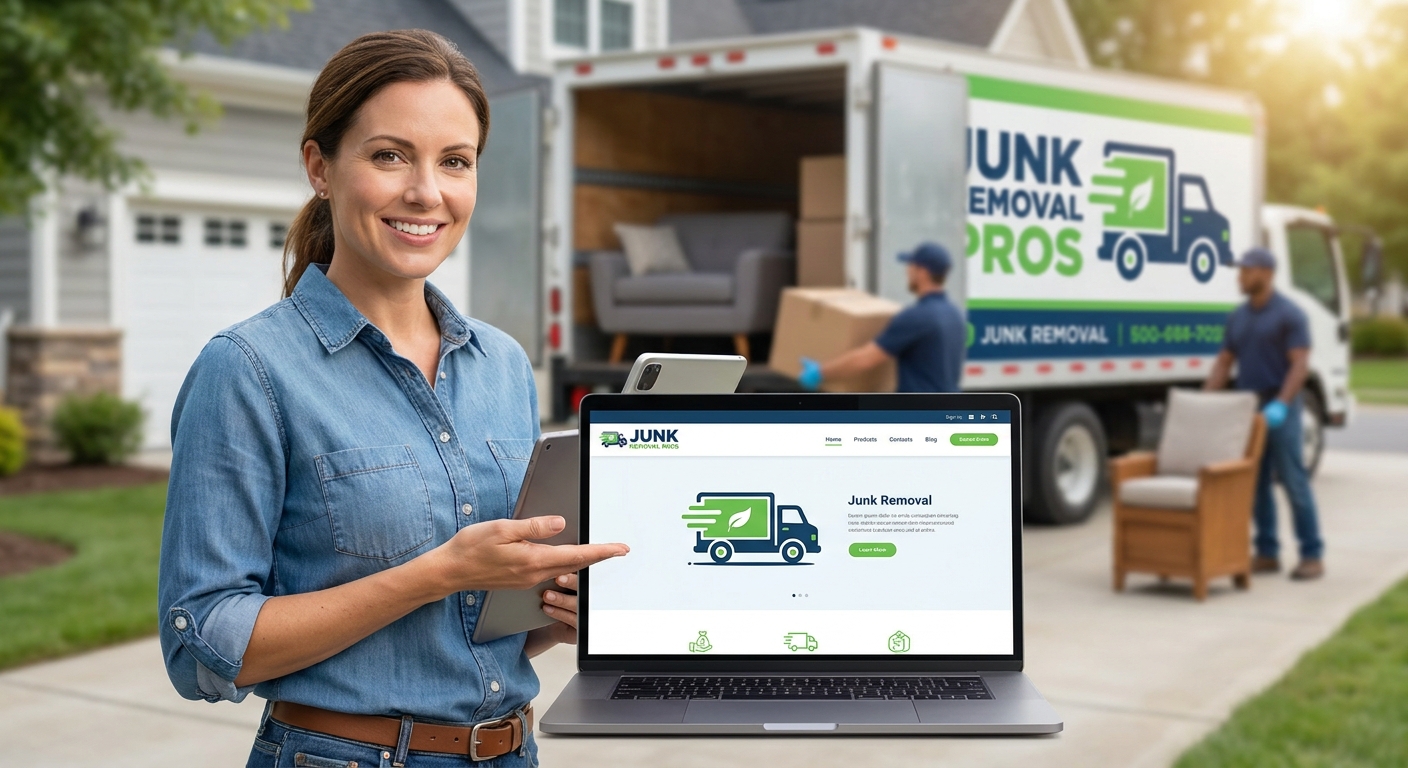
Junk removal companies compete on speed and trust, and the website either proves both in the first five seconds or loses the click to a competitor with a faster quote form. This guide ranks the website design elements that actually move the needle for junk removal businesses in 2026, not generic "look professional" advice.
- An instant quote request form beats a plain contact form for junk removal websites — put it above the fold. Buy this first.
- Before/after photo sets build more trust than stock photography for best website design for junk removal companies in 2026. Skip stock images entirely.
- Service-area landing pages (per city or ZIP) drive local search traffic that a single generic homepage never will. Build 3-5 before launch.
- Custom-coded sites load faster and hold up longer than drag-and-drop builders for a hauling business with heavy image galleries. Consider custom code over templates.
Why this matters
A junk removal customer searches, compares two or three sites, and calls the one that answers their question fastest: how much, how soon, and do you actually show up. The website is the sales call before the sales call.
Most junk removal sites fail on one of three things: no visible price range or quote path, no photo proof of the work, and pages that load slow on a phone in a driveway with two bars of signal. Fix those three and the rest of the design choices matter far less than owners think.
How this list was built
This ranking weighs each design element by how directly it affects a junk removal company's core conversion action — a phone call or a submitted quote request — and by how often that element is missing from junk removal sites built on generic templates. Elements that touch speed, trust, and local discovery rank higher than cosmetic choices like color palettes or font pairings, because those three drive the calls that pay the bills in 2026.
The ranked list
1. Instant quote request form — the conversion engine
A form that asks for photos, address, and a preferred pickup window converts better than a generic "contact us" box because it lets the customer skip the phone call entirely. Junk removal customers want a number fast, and a form that promises a response within 24 hours removes the biggest friction point in the buying decision. Verdict: Buy — this is the single highest-impact element on the page.
2. Before/after photo galleries — the trust builder
Stock photos of clean garages don't match what a customer's actual garage looks like, and buyers notice the mismatch immediately. Real photo sets from 5 or more recent jobs, shown before and after, do more to close the sale than any paragraph of copy. Pages built around photos that build trust consistently outperform generic stock-heavy pages on time-on-page. Verdict: Buy.
3. Service-area landing pages — the local traffic driver
A single homepage that says "serving the area" loses to competitors with dedicated pages for each city or ZIP code the truck actually covers. Search engines reward specificity, and a customer searching "junk removal near [city]" wants proof the company works there, not a vague service radius. Sites with local SEO features built in typically run 3 to 5 of these pages before their first full year. Verdict: Buy for any company covering more than one town.
4. Mobile page speed under 3 seconds — the dealbreaker
Junk removal searches happen on phones, often standing in the room that needs clearing out, and a site that takes longer than 3 seconds to load loses that visitor before the quote form even renders. Heavy image galleries built on drag-and-drop platforms are the most common cause of slow load times in this category. Verdict: Buy if the current site is template-based and slow; Skip any redesign that doesn't test speed on a real phone before launch.
5. Visible pricing structure — the differentiator
Junk removal customers hate the "call for a quote, we'll surprise you" model, and a page that shows a price range by load size or truck fraction wins the comparison shopper. A clear pricing page doesn't need exact dollar figures — a range or a "how pricing works" explainer builds enough trust to get the call. Verdict: Consider — high value, but only if the business is comfortable publishing ranges rather than exact numbers.
6. Google Business Profile integration and review display — the credibility signal
A junk removal site with zero visible reviews reads as untested, and pulling live Google reviews onto the site closes the trust gap faster than testimonial text the owner wrote themselves. This works alongside features built for local service businesses, which usually bundle review widgets with the quote form. Verdict: Buy — low effort, high trust return.
7. Custom code over a page-builder template — the durability pick
Template sites break under photo-heavy galleries, load slower as more service pages get added, and cost more to fix later than to build right the first time. A company that plans to add service-area pages every quarter needs a foundation that scales without a rebuild. Companies scaling this way often compare notes with moving company website design, since both trades share the same photo-heavy, quote-first structure. Verdict: Buy for any junk removal company planning to grow past a single truck.
“If the quote form takes more than two taps to reach, the junk removal website is already losing the call.”
Comparison at a glance
| Element | What it fixes | Effort to add | Verdict |
|---|---|---|---|
| Instant quote form | Slow response, lost calls | Low | Buy |
| Before/after photo galleries | Weak trust, generic feel | Medium | Buy |
| Service-area landing pages | Missing local search traffic | Medium | Buy |
| Mobile speed under 3 seconds | Visitors bouncing before quote loads | High (often needs rebuild) | Buy |
| Visible pricing structure | Comparison shoppers leaving | Low | Consider |
| Review widget / GBP integration | Untested feeling on first visit | Low | Buy |
| Custom code foundation | Slow, breakable template | High | Buy |
Get a junk removal website built right
Custom code, quote forms, and local pages — no upfront build fees.
Where to build it
- DIY builder platforms work for a single truck with no growth plans, but photo-heavy galleries and added service pages tend to slow these sites down within a year.
- Freelancers can be fast and cheap for a one-page site, but ongoing hosting, security, and speed maintenance usually fall back on the owner once the freelancer moves to the next project.
- A studio that builds custom code with hosting and support bundled in removes that maintenance burden and scales with the business as service-area pages get added — this is the model Nuvora runs under its Starter and Growth plans, with Tailored quotes for anything more specific.
A junk removal company weighing these routes should also check what small business website design generally needs before locking in a platform, since the fundamentals apply across trades before the industry-specific choices come in.
FAQ
What's the best website design for junk removal companies in 2026?
The best website design for junk removal companies in 2026 combines an instant quote request form, real before/after photo galleries, and service-area landing pages built on fast, custom-coded pages rather than a slow template. Companies missing any of those three lose calls to faster-loading competitors.
Do junk removal websites need visible pricing?
Not exact dollar figures, but a price range by load size builds more trust than a page that hides pricing entirely. Customers comparing two or three companies tend to call the one that sets expectations first.
Is a template builder good enough for a junk removal site?
A template builder can work for a single-truck operation with no growth plans, but photo-heavy galleries and added service pages usually slow these sites down within a year. Custom code holds up better as the business adds locations or services.
How many photos should a junk removal website show?
At least 5 recent before/after job photo sets give visitors enough proof to trust the quote. Stock photography of clean garages does the opposite — it reads as generic and unconvincing.
How fast should a junk removal website load on mobile?
Under 3 seconds is the target, since most junk removal searches happen on a phone in the room that needs clearing. Slower load times cause visitors to bounce before the quote form even appears.
How many service-area pages does a junk removal company need?
Most companies covering more than one town run 3 to 5 dedicated city or ZIP pages rather than one generic service-area statement. Each page targets the specific local search a customer in that area actually types.
Should reviews be displayed directly on the website?
Yes — pulling live Google reviews onto the site closes the trust gap faster than testimonial text the owner writes alone. It's one of the lowest-effort, highest-return elements on this list.
What's the biggest mistake junk removal websites make?
Hiding the quote path behind multiple clicks or a slow-loading photo gallery. If the quote form takes more than two taps to reach, the site is losing calls before it ever gets credit for them.
One last thing
The junk removal companies that grow past one truck almost always rebuilt their site around the quote form first and the photo gallery second — not the other way around. Owners tend to obsess over making the site "look nice" before fixing the two-tap rule, and that order costs calls every week the old structure stays live.