July 24, 2026
Website Design for Dentists: What to Pick in 2026
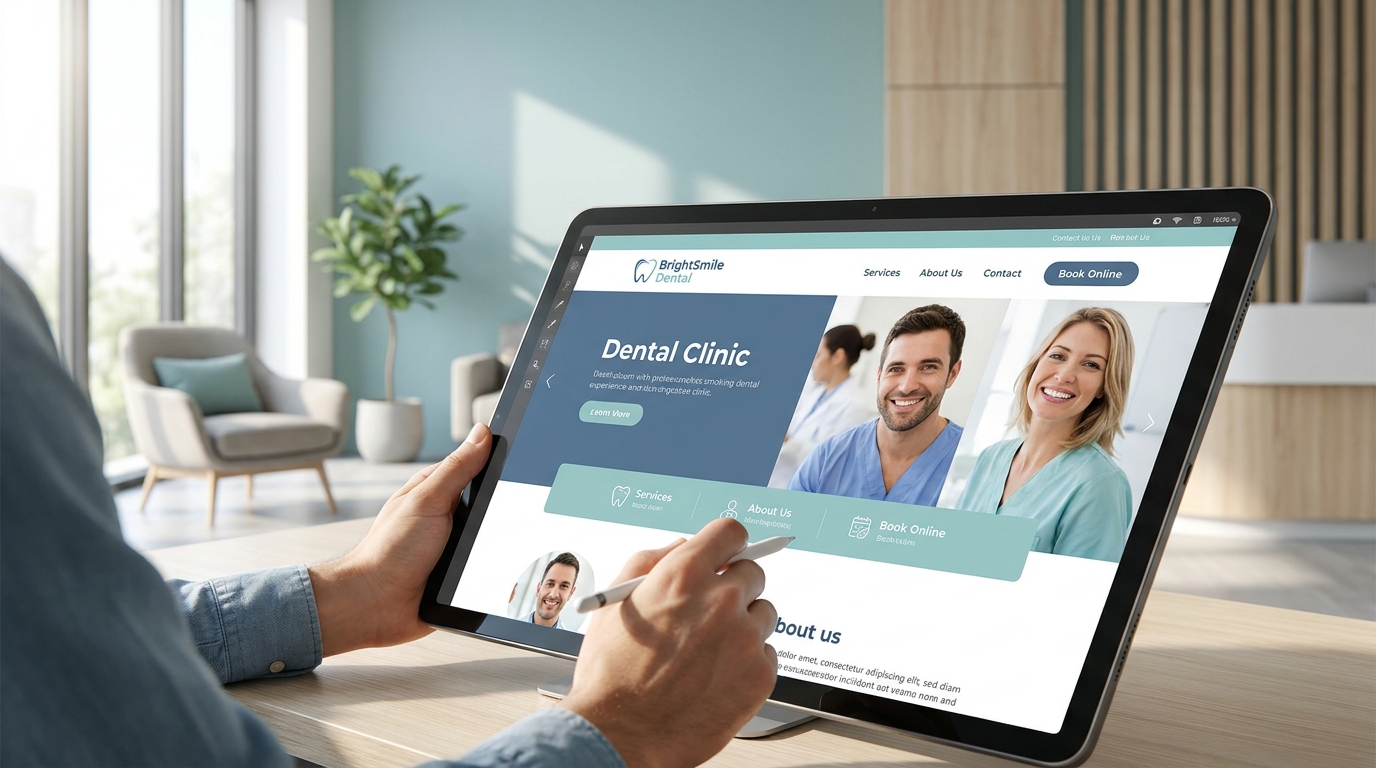
Choosing website design for dentists in 2026 means picking between DIY builders, freelance developers, marketing agency retainers, and flat-fee subscription studios like Nuvora - and the wrong pick costs you patient bookings for years, not months.
- Website design for dentists needs online booking, mobile-first layout, and WCAG 2.1 AA accessibility - not a template with a stock tooth logo.
- DIY builders like Wix or Squarespace: Skip for multi-provider practices - they can't scale with staff or location pages.
- Freelance developers: Consider for a single-location practice on a tight budget, but plan for maintenance gaps.
- Marketing agency retainers: Consider if budget supports ongoing spend, but launch timelines run long.
- Flat monthly subscription builds, the model Nuvora runs: Buy - no upfront build fee, human QA, cancel with notice.
Why this matters
A dental practice website isn't a brochure. It's the booking funnel, the trust signal for a new patient deciding between three practices in the same zip code, and the thing your front desk staff points to when someone asks "do you take my insurance." In 2026, most of that decision happens on a phone screen before anyone calls the office.
Get the build wrong and you don't just lose a pretty site - you lose the patient who bounced because the booking widget didn't load or the intake form looked like it was built in 2016. Get it right and the site becomes the quietest, steadiest source of new patient volume the practice has.
Who this is for
This guide is for practice owners, office managers, and dental group marketing leads evaluating website design for dentists in 2026 - whether that's a single-doctor general practice, a multi-location group, or a specialty practice (ortho, oral surgery, pediatric) trying to decide between a DIY tool, a freelancer, an agency, or a subscription studio.
What to look for in website design for dentists
Online booking that actually syncs
A "Request an Appointment" button that just emails the front desk isn't booking - it's a form. Real integration ties into the practice management system or at minimum routes requests with the right urgency flags, so a same-day toothache doesn't sit in an inbox until Monday.
Mobile-first layout, not mobile-friendly
There's a difference between a site that "works" on mobile and one designed for it first. Tap targets sized for thumbs, forms that don't require pinch-zooming, and a phone number that's a tap-to-call link, not an image of text.
HIPAA-aware intake forms
Dental sites collect names, insurance details, and sometimes health history through contact forms. That data needs to move through a form built with privacy in mind, not a generic contact widget bolted onto a template in an afternoon.
Local SEO structure for every location
A single-location practice needs one strong local page. A group with four offices needs four distinct location pages with unique NAP data, embedded maps, and location-specific schema markup - not one page with a dropdown.
Core Web Vitals that pass
Google's Largest Contentful Paint threshold sits at 2.5 seconds for a "good" score. Miss it and the site quietly loses ranking position to a competitor who didn't.
Accessibility compliance built in
Dental practices have faced ADA website accessibility lawsuits tied to WCAG 2.1 AA standards. A site without alt text, keyboard navigation, and color contrast checks is exposure, not just a design gap.
Top picks for website design for dentists
DIY builders (Wix, Squarespace, GoDaddy) - the free-feeling pick. One flat template price, no developer needed, launch in a weekend. The catch: adding a second location or a booking integration usually means rebuilding the page structure from scratch. Skip for anything beyond a single provider with a simple schedule.
Freelance developer - the custom one-off. You get a site built to spec, often the cheapest custom option up front. The risk is the single point of failure - if that person disappears, so does anyone who understands the codebase, and updates stall. Consider for a single-location practice with a modest budget and no urgency around ongoing changes.
Marketing agency retainer - the full-service pick. Agencies bundle strategy, ads, and design, which suits a group practice already running paid campaigns. Launch timelines commonly stretch past 90 days once strategy decks and revision rounds are added in. Consider if the practice already has agency-scale marketing spend and wants everything under one contract.
Flat monthly subscription build (Nuvora's model) - the no-upfront-fee pick. No large build invoice before launch, hosting and maintenance folded into one monthly plan, and cancellation with notice instead of a long contract lock-in. The build is custom, not a template swap - Nuvora's process pairs a human designer with QA on every site, not an auto-generated theme. Buy for practices that want a custom site without a five-figure invoice on day one.
Marketplace/directory-bundled sites (the kind that come free with a review-management or SEO tool subscription) - the bundled pick. Convenient, but the design and code are locked to that vendor's platform, so leaving the bundle often means losing the site. Skip unless the practice is fine being tied to that vendor indefinitely.
What to avoid
- Stock dental templates with a swapped logo. They load fast in a demo, but every practice using the same theme looks identical to a patient comparing three sites in one sitting.
- "Free" website offers bundled into a marketing platform. The site usually can't be exported, so switching platforms later means starting over.
- Agencies quoting a fixed price with no maintenance plan attached. A site with no update plan for browser changes or plugin patches degrades within a year, often silently.
Verdict comparison
| Option | Upfront cost | Launch speed | Ongoing maintenance | Verdict |
|---|---|---|---|---|
| DIY builder | Low, template fee | Fast (days) | Manual, on you | Skip for multi-provider |
| Freelance developer | Custom quote, one-time | Weeks | Not included by default | Consider for simple, single-location |
| Marketing agency retainer | High, ongoing retainer | 60-90+ days | Included in retainer | Consider for ad-heavy groups |
| Subscription build (Nuvora) | No upfront build fee | Weeks | Included monthly | Buy |
| Bundled/directory site | Often "free" | Fast | Vendor-controlled | Skip if portability matters |
FAQ
What's the best website design for dentists in 2026?
The best option in 2026 is a custom-built, mobile-first site with real booking integration and WCAG 2.1 AA accessibility built in - not a stock template. A flat monthly subscription build avoids a large upfront invoice while still delivering a custom design.
Is a subscription website better than a one-time build for a dental practice?
For most single-to-multi-location practices, yes - a subscription model removes the large upfront bill and folds hosting, maintenance, and updates into one monthly plan. A one-time build can work for a simple single-provider site with no plans to add locations or booking features.
How much does dentist website design cost in 2026?
Cost varies by studio and by whether the model is a one-time build, a retainer, or a flat monthly subscription - request current pricing directly from any provider you're evaluating rather than relying on a published range.
Do dental websites need HIPAA-compliant contact forms?
Any form collecting patient health information or insurance details should be built with privacy handling in mind, even if the site itself isn't a HIPAA-covered entity. Generic contact widgets often aren't built for that data.
Should a dental website include online booking?
Yes - a booking widget that routes requests properly, rather than just emailing the front desk, reduces missed same-day requests. Practices without real booking integration rely entirely on phone calls during office hours.
How long does it take to launch a new dental practice website?
DIY builders can launch in days, freelance builds typically take a few weeks, agency retainers often run 60 to 90+ days with strategy and revision rounds, and subscription builds like Nuvora's typically land in the weeks range since there's no lengthy proposal cycle.
Is Wix or Squarespace good enough for a dental practice?
For a single provider with a simple schedule and no plans to add locations, a DIY builder can work short term. Once a second location, real booking integration, or accessibility compliance becomes a priority, template builders start showing their limits.
Does a dental website need ADA/WCAG accessibility compliance?
Dental practices have faced legal exposure tied to inaccessible websites, and WCAG 2.1 AA is the standard most commonly referenced. Alt text, keyboard navigation, and color contrast should be part of the build, not an afterthought.
One last thing
Most dental practices don't lose patients because their website looks dated - they lose them because the booking button doesn't work on the phone the patient is actually holding. Test that one button before evaluating anything else on the page.
Related guides
- Restaurant website design guide - the same flat-fee subscription model applied to a different local service business, worth a read if you're comparing build models across industries.