August 5, 2026
Web Design for Pest Control Companies: 2026 Guide
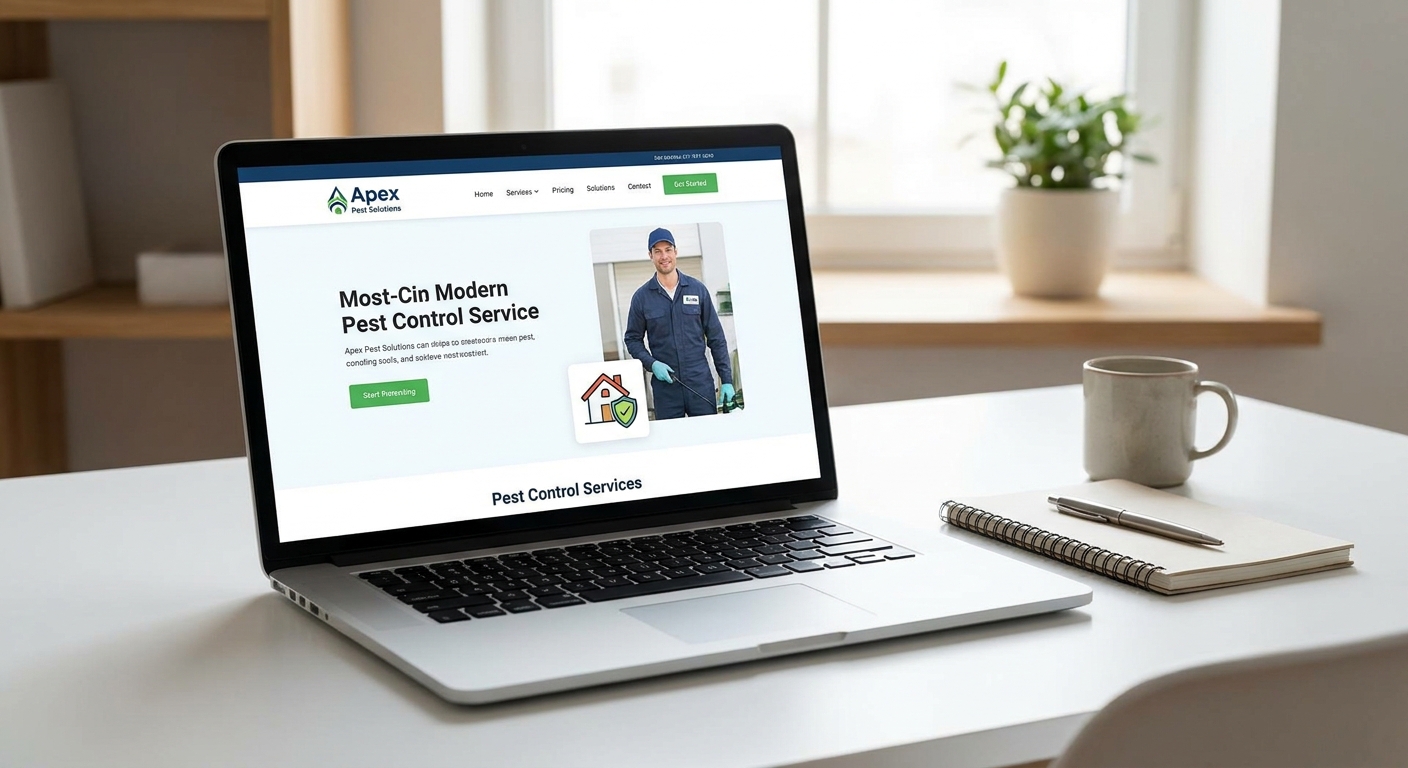
Pest control companies live and die by local search and same-day trust. A slow, generic website loses jobs to the competitor whose site loads faster and answers "how much" before the phone rings.
- Custom-coded sites beat template builders for web design for pest control companies on speed and mobile conversion in 2026.
- Service-area pages and a visible quote form are non-negotiable — Buy the setup, Skip the generic contact-only homepage.
- CRM and booking integrations turn phone-tag into booked jobs; Consider these before a full redesign.
- Security matters more than owners think — customer addresses and payment details need real protection, not a page builder plugin.
Why this matters
Pest control is a trust sale made under time pressure. Someone finds ants in the kitchen or a termite inspector's card on the door, searches on a phone, and picks from whoever answers fastest and looks legitimate.
A website that loads in three seconds, shows a real technician, and lets a visitor request a quote in under a minute wins that moment. One built on a slow theme with stock exterminator photos and a buried phone number loses it, and by 2026 that gap in conversion only widens as more service searches happen on mobile.
Who this is for
This guide is for pest control company owners and operators — single-technician outfits, regional franchises, and multi-service exterminators covering termites, rodents, and mosquito treatment — who need a site that generates calls and quote requests, not just a digital business card. If your current site was built five years ago on a builder plugin and hasn't been touched since, this is the starting point before you spend on ads. The same logic behind local SEO features for small business websites applies directly here: pest control is a hyper-local, near-me category, and your site structure has to match that.
What to look for in web design for pest control companies
Service-area pages that match how people search
Customers search "pest control [city name]" or "termite treatment near me," not your brand name. A single homepage covering five counties can't rank for all of them. Dedicated pages per service area, each with real content about that location, give Google something specific to match against the query.
A quote or inspection request built into the flow
Pest issues create urgency. If the only way to reach you is a phone number in 8-point font at the bottom of the page, you're losing visitors who'd rather type than call at 11pm. A short form — address, pest type, preferred time — captures leads your competitors miss.
Trust signals that hold up under scrutiny
Licensing numbers, insurance mentions, and real reviews matter more in pest control than in most local services, because customers are letting a stranger with chemicals into their home. A page that just says "licensed and insured" without proof reads the same as one that's lying.
Mobile speed and one-tap calling
Most of this traffic is mobile, searching in a moment of frustration. A click-to-call button that actually works, and a page that loads before the visitor gives up, matters more here than almost any design flourish.
CRM and lead routing that doesn't drop jobs
A quote form that dumps into an inbox nobody checks on weekends is worse than no form at all. Integration with scheduling and CRM tools, like what's covered in best CRM integrations for small business websites, routes a lead to the right technician instead of letting it sit for three days.
Security for customer data
Addresses, phone numbers, and sometimes payment details move through your site. A neglected plugin-based builder is a common attack surface; a custom-coded site with maintained hosting closes that gap.
The five things your website actually needs
1. A homepage that states the service area and the problem, first. The hook: no fluff above the fold. One number that matters: visitors decide to stay or bounce inside the first 3 seconds. Verdict: Buy.
2. Individual service pages for each pest type (termites, rodents, bed bugs, mosquitoes). The hook: this is where the SEO volume actually lives, not on one crowded "services" page. One spec: a site with 5-6 focused service pages out-ranks a single catch-all page for long-tail terms almost every time. Verdict: Buy.
3. An online quote form tied to scheduling. The hook: this is the difference between a brochure and a lead machine. Pair it with the guidance in best booking systems for small business websites if you're choosing the tool underneath it. Verdict: Buy.
4. A reviews or case-results page, not just three testimonials on the homepage. The hook: pest control buyers cross-shop reviews harder than almost any other local category. One number: a page with 15-20 recent reviews reads as active; three from 2021 reads as abandoned. Verdict: Consider if you don't have volume yet — build it as reviews accumulate.
5. A chatbot with no human follow-up. The hook: it looks modern, it answers nothing useful, and it frustrates a customer who wants a real answer about a rodent infestation at 9pm. Verdict: Skip unless it's staffed or routes straight to a live line.
What to avoid
- Stock photography of technicians in full hazmat gear. It looks alarming, not professional, and it doesn't match what a routine treatment actually looks like.
- Page builder templates that break the moment you add a booking widget. They look fine in the demo and fall apart under a real quote form.
- A "contact us" page as the only conversion path. Pest control customers want speed, not a form that promises a callback "within 48 hours."
Get a custom pest control site built
Design, development, hosting, and support in one plan. No upfront build fees.
Verdict comparison table
| Approach | Speed | Security | Mobile UX | Cost structure | Verdict |
|---|---|---|---|---|---|
| DIY drag-and-drop builder | Slow with plugins added | Weak, plugin-dependent | Inconsistent across themes | Cheap upfront, rising add-on costs | Skip |
| Off-the-shelf template theme | Moderate | Moderate | Decent but generic | Low upfront, limited flexibility | Consider for a single-technician startup |
| Custom-coded site | Fast by design | Maintained, no bloat plugins | Built for the actual funnel | Flat monthly plan, no upfront build fee | Buy |
Web design for pest control companies in 2026 comes down to that middle column more than owners expect — security failures on neglected sites are one of the more common reasons a local service business loses its Google ranking overnight.
FAQ
What should a pest control company website include?
A pest control website needs individual service pages by pest type, a service-area page per city or county, an online quote form, licensing and insurance details, and recent customer reviews. A homepage alone with just a phone number underperforms in 2026.
How much does a pest control website cost in 2026?
Costs vary by scope, but flat monthly subscription plans that bundle design, hosting, and support with no upfront build fee are common in 2026 and avoid the large one-time invoice of a traditional custom build.
Do pest control companies need local SEO?
Yes. Pest control is a near-me search category, so service-area pages and a complete Google Business Profile matter as much as the homepage itself.
Can I use a website builder like Wix or Squarespace for a pest control site?
You can, but builders slow down once you add booking widgets, CRM integrations, and multiple service-area pages. A custom-coded site handles that load without breaking.
How long does it take to build a pest control company website?
Timelines depend on scope and how much existing content you provide, but a focused site with core service and area pages moves faster than a large multi-location build.
Is website security a real concern for a small pest control business?
Yes. Sites collect customer addresses and sometimes payment info, and outdated plugin-based builders are a common entry point for attacks. Regular maintenance closes that gap.
Does a pest control website need online scheduling?
It should. Customers searching for pest control expect to request a quote or inspection time immediately, not wait for a callback.
What's better for pest control: a template theme or a custom site?
A custom-coded site wins on speed, security, and mobile conversion. A template theme can work as a stopgap for a brand-new single-technician operation, but it caps growth fast.
One last thing
The detail most pest control owners miss isn't design, it's decay. A site built in 2022 without maintenance has been quietly losing rankings for two years while a competitor's actively-updated site climbs past it — the fix isn't a full redesign, it's ongoing upkeep, which is exactly why hosting and support belong in the same plan as the build.