August 4, 2026
Web Design for Tattoo Studios in 2026: What to Buy
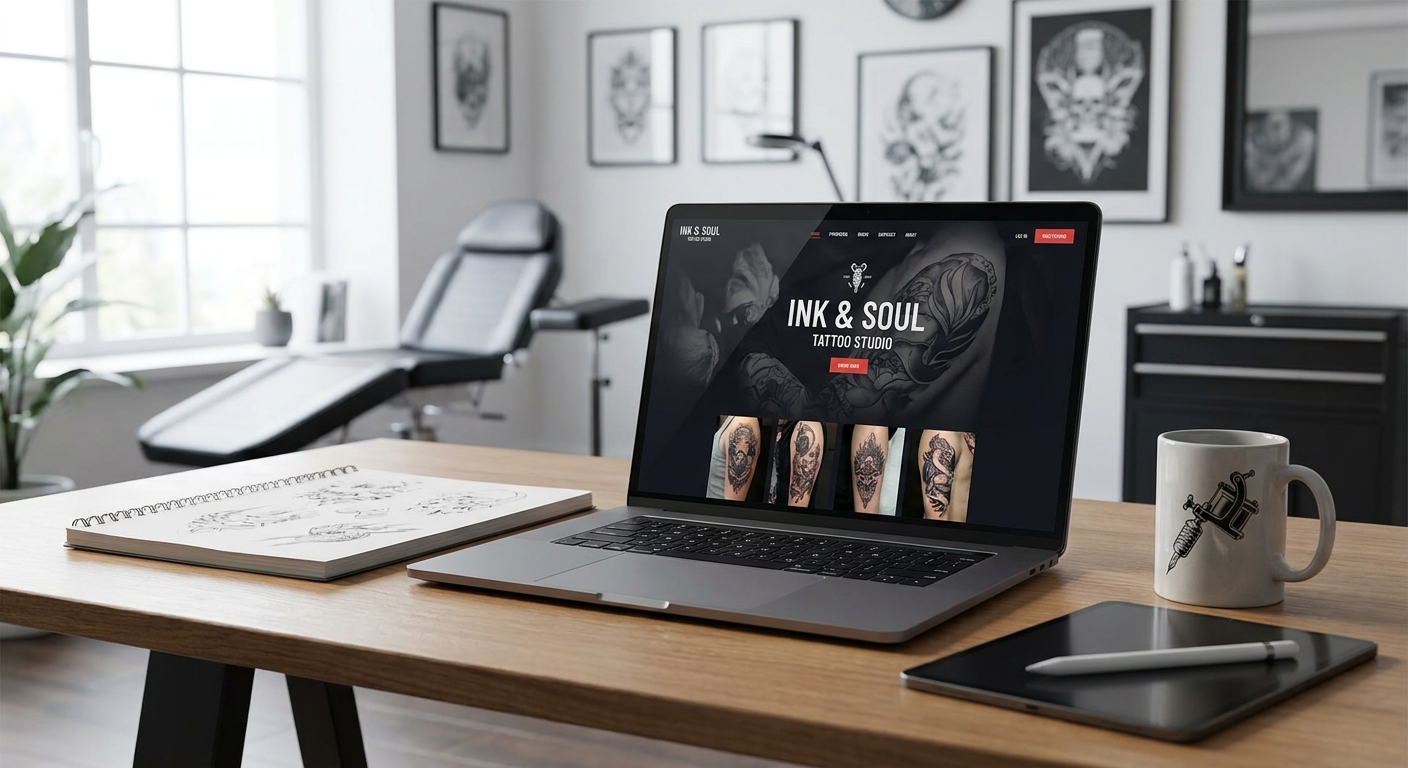
Tattoo studios sell trust through images, not paragraphs. A tattoo studio website has to carry high-resolution portfolio shots, handle deposit bookings, and keep consult forms working on a phone screen in a dim studio with bad Wi-Fi — a generic template rarely does all three.
- Web design for tattoo studios needs portfolio galleries, deposit-based booking, and per-artist pages — a plan like Nuvora's Growth tier covers all three. Buy.
- Single-chair studios rarely need multi-artist tooling — Nuvora's Starter plan covers a one-artist shop without paying for features you won't use.
- Studios selling flash prints, prints, or merch need e-commerce built into the site, which usually means a Tailored quote instead of a page-builder template.
- Instagram-only portfolios don't rank on Google in 2026 — a real site with local SEO still wins the search for 'tattoo shop near me.'
Why this matters
Most people picking a tattoo artist scroll a portfolio before they read a single sentence about the studio. If that portfolio lives only on Instagram, you're competing for attention inside someone else's feed, subject to someone else's algorithm changes.
A custom website puts the studio in control: gallery order, artist bios, booking flow, and what shows up when someone searches your city plus "tattoo shop." Nuvora builds that kind of site on custom code, not a drag-and-drop template, which matters once you're loading dozens of high-resolution images per artist.
Deposits are the other piece people underrate. A booking form that collects a deposit before a consult cuts no-shows — a plain contact form doesn't do that job.
Who this is for
This guide is for studio owners and managers running one to six chairs who are past the Linktree-and-Instagram phase and need a site that books consults, shows real work, and holds up to Google search in 2026. If you've got two or more artists with different specialties — black-and-grey, color realism, fine line — you're the exact buyer profile this guide is written for.
What to look for in web design for tattoo studios
Portfolio-first gallery structure
The homepage has to lead with images, not a hero banner of stock photography. Galleries organized by style (traditional, blackwork, fine line) let a visitor filter to what they came for in under 10 seconds, which is roughly how long you have before they bounce back to Instagram.
Per-artist pages
A studio with three or more artists needs individual pages, each with its own gallery, bio, and booking link. Lumping every artist's work into one grid makes it impossible to tell whose portfolio you're looking at, and clients book people, not studios.
Deposit-based booking
A consult request form that also collects a deposit reduces no-shows in a way a plain "contact us" form never will. This is the single feature that pays for a website subscription fastest for a busy shop.
Age verification and consent forms
Studios need waiver and consent language built into the booking flow, not bolted on as a PDF nobody reads. Handling this on the site, rather than in person at the chair, saves five minutes per client and keeps records organized.
Local SEO for "tattoo shop near me"
A site with proper local SEO features — a real address, service-area pages, review schema — shows up when someone searches your city plus "tattoo shop" in 2026. Instagram profiles don't rank for that query; a website does.
Fast load times on image-heavy pages
A gallery-heavy site that loads slowly kills the exact traffic it's built to win, since most tattoo research happens on a phone on someone's commute. Compressed, custom-coded galleries load faster than a stock page-builder theme carrying the same photo count.
Top picks by studio size
The single-artist pick: Starter. One chair, one portfolio, one booking form — that's the whole job for most solo studios. Custom code keeps galleries fast without paying for multi-artist tooling you don't need yet. Buy if you're one artist running your own chair in 2026.
The multi-artist pick: Growth. Once a studio runs three or more artists, per-artist pages and a real booking system that handles deposits stop being optional. This tier is built for shops adding chairs, not shrinking them. Buy if you've got two or more artists and a booking calendar that's getting hard to manage by DM.
The merch-and-shop pick: Tailored. Studios selling flash prints, apparel, or gift cards need e-commerce wired into the site, plus whatever one-off technical work that requires. A flat subscription tier won't fit every studio's build, which is exactly what a Tailored quote is for. Consider if you're planning to sell product alongside bookings; Skip it if you're not selling anything beyond the tattoo itself.
Get a quote for your studio's site
Custom code, portfolio galleries, and deposit booking — no upfront build fees.
What to avoid
- Page-builder templates dressed up as "custom." They load slower under a heavy photo count and rarely support per-artist galleries cleanly.
- Instagram as the only web presence. It doesn't rank for local search in 2026 and gives you zero control over layout or booking flow.
- Dark, busy homepages that bury the portfolio. A studio's aesthetic belongs in the tattoos, not in a homepage so cluttered the gallery loads below the fold.
Verdict comparison
| Criteria | Starter | Growth | Tailored |
|---|---|---|---|
| Portfolio galleries | Yes, single artist | Yes, per-artist | Custom scope |
| Deposit booking | Basic form | Full deposit flow | Custom flow |
| E-commerce / merch | No | No | Yes |
| Best for | Solo chair | 2+ artists | Studios selling product |
| Verdict | Buy for solo shops | Buy for multi-artist shops | Consider if selling merch |
FAQ
What's the best web design approach for tattoo studios in 2026?
A custom-coded site with style-based portfolio galleries, per-artist pages, and deposit-based booking performs best. Template builders struggle once a studio is loading dozens of high-resolution images per artist.
Is a website better than Instagram for a tattoo studio?
Yes — Instagram doesn't rank for local search queries like 'tattoo shop near me,' while a real website with local SEO can. Instagram still helps with reach, but it shouldn't be the only booking channel.
Do tattoo studios need separate pages for each artist?
Studios with two or more artists need individual pages, since clients research and book specific artists, not the shop as a whole. A shared gallery makes it hard to tell whose work is whose.
Should a tattoo studio website collect deposits?
Yes, a deposit-based booking form cuts no-shows more effectively than a plain contact form. This is one of the fastest-paying features on a studio website.
Does a tattoo studio website need e-commerce?
Only if the studio sells flash prints, apparel, or gift cards separate from tattoo appointments. Studios doing bookings only rarely need a shop built into the site.
How long does it take to build a tattoo studio website?
Timelines depend on scope — a single-artist portfolio site moves faster than a multi-artist build with deposit booking and consent forms. Custom code takes longer up front than a template but holds up better under heavy image galleries.
Is a subscription website plan worth it for a small tattoo shop?
A subscription plan that bundles design, hosting, and support avoids a large upfront build cost, which matters for a shop with one or two chairs. Check current plan details before committing to a tier.
What photos should a tattoo studio website use?
High-resolution shots of healed and fresh work, organized by style, build more trust than stock photography or low-quality phone snaps. Photo quality is one of the fastest ways to separate a serious studio site from a placeholder one.
One last thing
The studios that book fastest off their site in 2026 aren't the ones with the flashiest homepage animation — they're the ones where a visitor can find a specific artist's black-and-grey work and hit "book consult" in three clicks. Every design decision on a tattoo studio website should get judged against that path, not against how it looks in a portfolio screenshot.